Curta mechanical calculator manual
Introduction
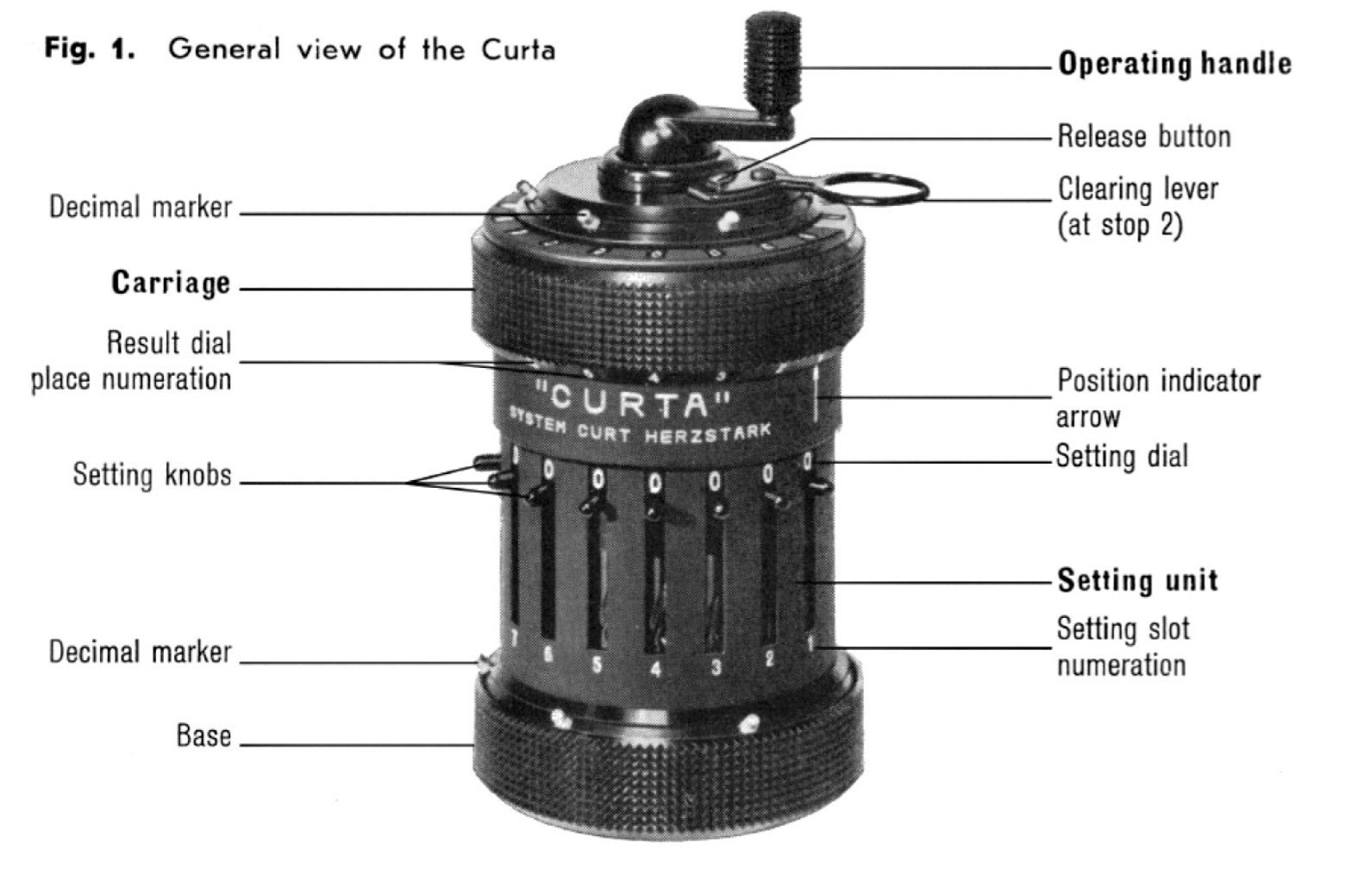
The purpose of this manual is to show you how to make the best use of your Curta, profiting from its pre-eminent qualities and efficiency.
Before reading further, may we remind you that the little Curta is a precision instrument, and should be treated as such. Never handle it roughly. From the first calculation which you make with it, you will discover for yourself how smoothly it runs. Also avoid all exposure to contamination such as sand, tobacco, water, etc.; always remebering to replace it in its dust and shock-proof container after use. So treated your Curta will last you a lifetime, and remain and indispendisable aid always ready to hand.
You can be entirely confident of its precision; the little Curta is born of long experience in the field of calculating machines. It is manufacted in one of the most up-to-date factories by international specalists in fine mechanics, with superior quality metals. No artificial materals whatsoever are used in its construction. Every one of its parts has been thoroughly checked, and finally the entire machine is subjected to numerous tests before leaving the factory.
Should your CURTA show any signs of trouble, do not on any account try to force it. Do not try to repair it yourself, nor confide it to unqualified hands, but return it to our agent. All our Main Agencies have a repair service with skilled mechanicians, specialists in the Curta machine, who will rapidly restore it to working order. Each machine is given a guarantee for one year, convering all defects which might occur in the course of normal use during that period. This guarantee does not, however, cover damage caused by violence.
The Curta requires no special care apart from the advice given above. Never try to oil it yourself! You might damage it in this way.
And now, it only remains for you to read carefully the instructions for use, and try out all the calculation examples described there. We have taken some truoble to set out these instructions as conveniently as possible, completed by a series of illustrations and some practical specimen calculations.
Description and handling of the Curta
General appearance
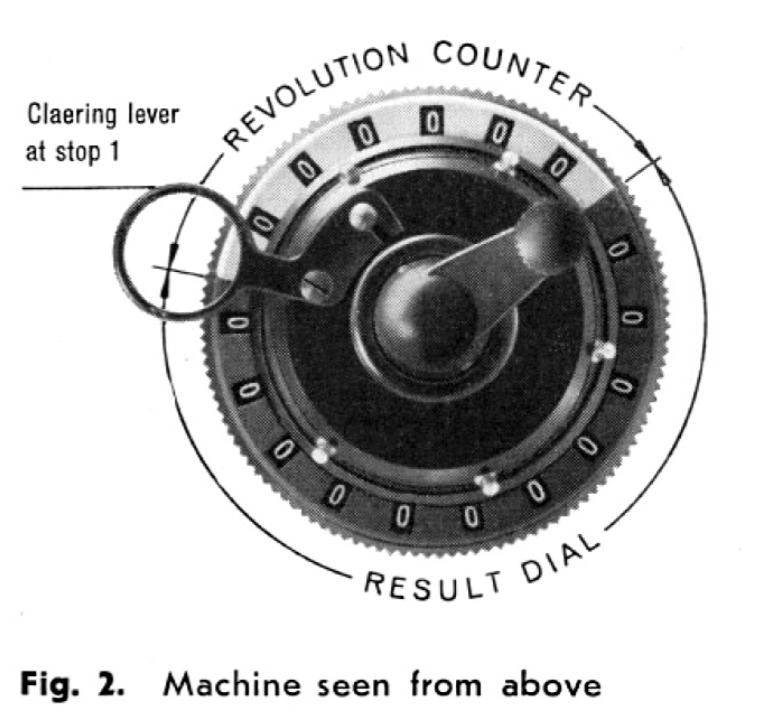
Looking at the outside of the machine, you will distinguish at once three main elements (see Figs.1 and 2).
- The cylindrical body, with the eight-columned setting unit.
- The operating handle.
- The rotatable cylindrical carriage, which contains the result counter (dark dial with 11 places), and the revolution counter (white dial with 6 places). (See Fig. 2.)
The number set is transferred to the result dial once for each turn on the operating handle, and the number of these turns is recorded in the revolution counter. In this way x turns of the handle produces multiplication by x.
In the following chapters these elements are described, together with all the accessory fittings which make the Curta a universal calculation machine.
Setting
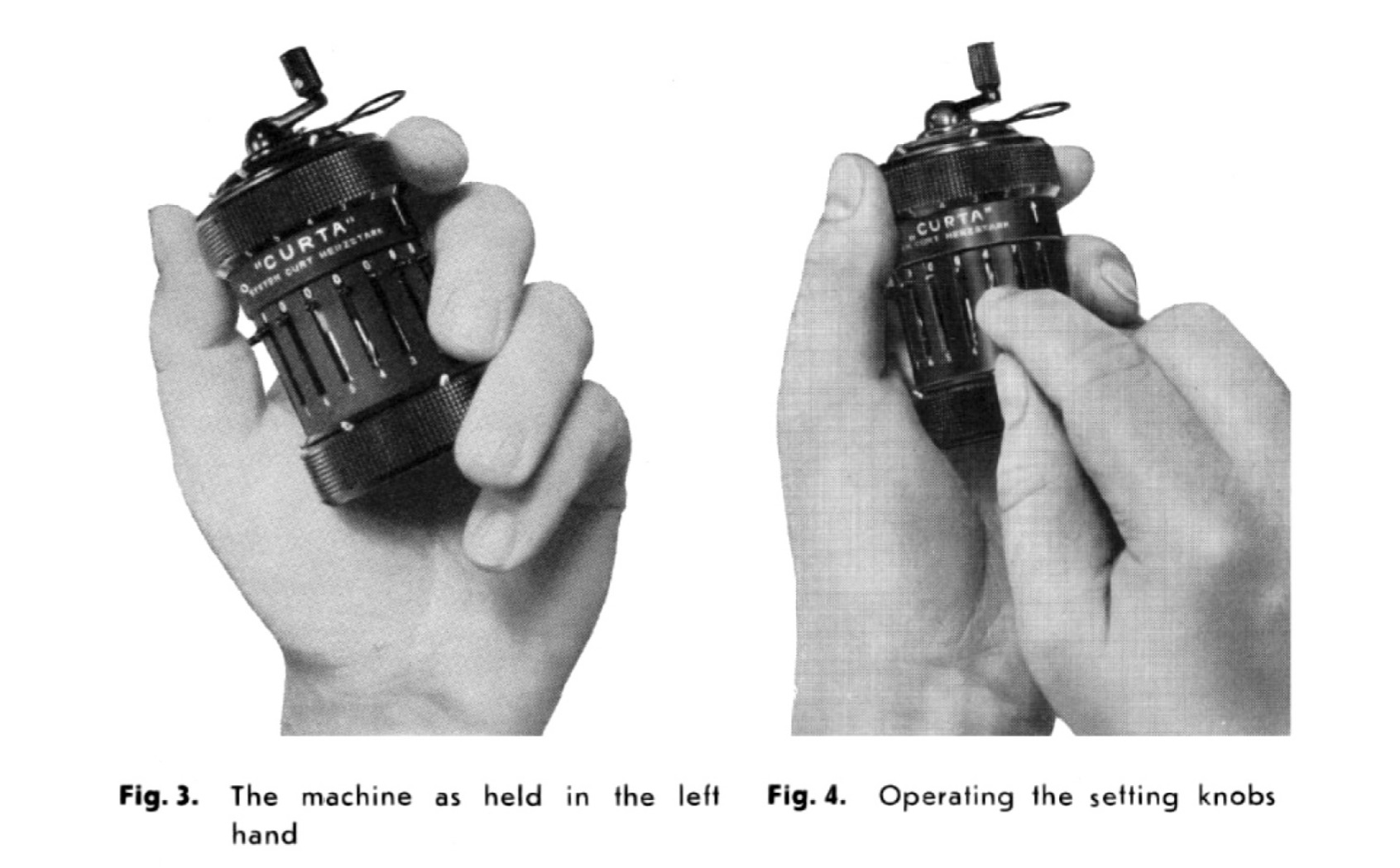
The figures are set by means of eight setting knobs, which project from slots in the main body numbered from 1 to 8.
To set a number, e. g. 13,977; take the machine in the left hand (see Fig. 3), and with the forefinger of the right hand (Fig. 4), pull the knobs 1 to 5 until the required figures appear, in this case 1, 3, 9, 7, 7, in the respective slots of the setting dial. (See Fig. 1.) The knobs are best held between the nail and the finger-tip.
To clear the setting dial the knobs are pushed right to the top of their slots.
The slots are numbered 1 to 8, starting from the right. 1 is the units column, 2 the tens column, 3 the hundreds, and so on (see Fig. 1). Underneath the slots, in the base ring, are three movable white buttons to mark the decimal point, thousands column, etc.
The handle
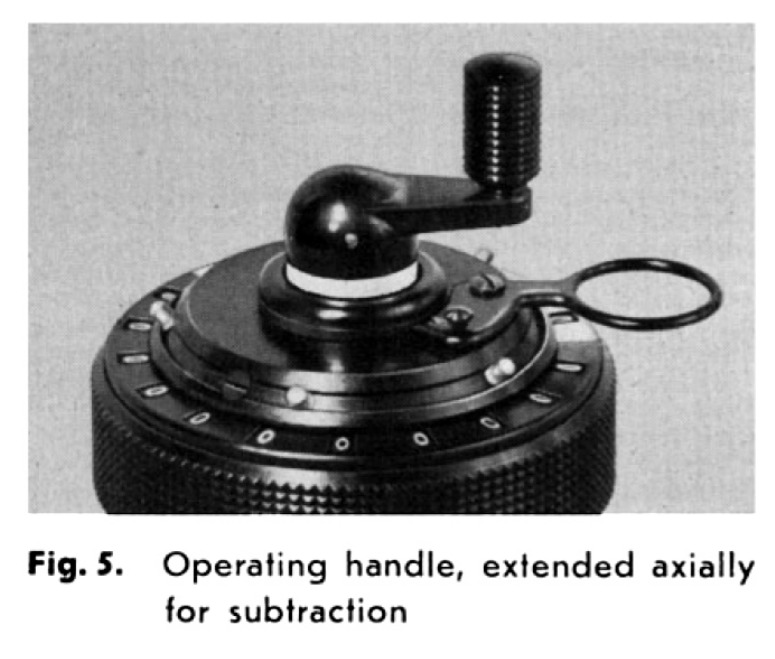
A number set is transferred to the result dial by one complete turn of the operating handle, always in a clockwise direction. At the end of each turn the handle is checked by an easily noticeable stop. Once begun a turn of the handle must always be completed. No operation of the machine whatsoever must ever be effected without the handle resting at the stop.
When it is at the stop, and only then, can the handle be pulled axially further out.
A turn of the handle in the lower position produces addition of the number set to that on the result dial (additive turn); a turn of the handle in the upper position, equally in a clockwise direction, produces subtraction of the number set (subtractive turn). A white collar is visible on the handle axis in the latter case (Fig. 5), to distinguish clearly the two positions, and exclude any possbility of error especially after ending a turn. A safety locking prevents axial displacement of the handle during rotation, which would otherwise produce incorrect results,
If in rapid calculation you start one turn too many, it must be completed, and then eliminated by a turn of the handle with the axis in the other position.
The counters
The 11-place result dial shows the totals, products or differences. The places are numbered 1 to 11 on the lower edge of the carriage (Fig. 1).
The 6-place revolution counter shows the number of turns completed. Its use in addition, for example, is to record the number of terms added together; but it is specially useful in multiplication, to check the multiplier.
Five white decimal markers serving to mark decimal points for both the dials can be shifted in a slot (Fig. 1 and 2).
Both the counters are provided with a continuous tens-carrying mechanism, the importance of which will be seen in the following chapters, Its presence in a universal calculating machine can be checked in this way: set 1 in the unifs column of the setting dial, and make a subtractive turn; both result and revolution counter dials will show nines. Then make an additive turn, and the set number, 1, will be carried from place to place in the dials, so that zeros reappear throughout.
Carriage position
 The handle being at its stop, the carriage may be raised, and turned
about the axis of the machine, within an angle range of about 100°
in which the carriage can be rested in any one of six posifions, An
indicator arrow engraved in white on the cylindrical main body (Fig. 1)
marks these stop positions of the carriage relative to the columns. If
the arrow points to the 1 of the result dial place numeration, the number
set is transferred unaltered to the resulf dial. With the arrow at 2,
the number is transferred 10 times; at 3, a hundred times, and so on. The
turns are recorded in the revolution counter in corresponding places; the
counter having six places, the carriage can be moved into six positions.
Such changes of position are needed, for example, in multiplication
with multipliers having several digits.
The handle being at its stop, the carriage may be raised, and turned
about the axis of the machine, within an angle range of about 100°
in which the carriage can be rested in any one of six posifions, An
indicator arrow engraved in white on the cylindrical main body (Fig. 1)
marks these stop positions of the carriage relative to the columns. If
the arrow points to the 1 of the result dial place numeration, the number
set is transferred unaltered to the resulf dial. With the arrow at 2,
the number is transferred 10 times; at 3, a hundred times, and so on. The
turns are recorded in the revolution counter in corresponding places; the
counter having six places, the carriage can be moved into six positions.
Such changes of position are needed, for example, in multiplication
with multipliers having several digits.
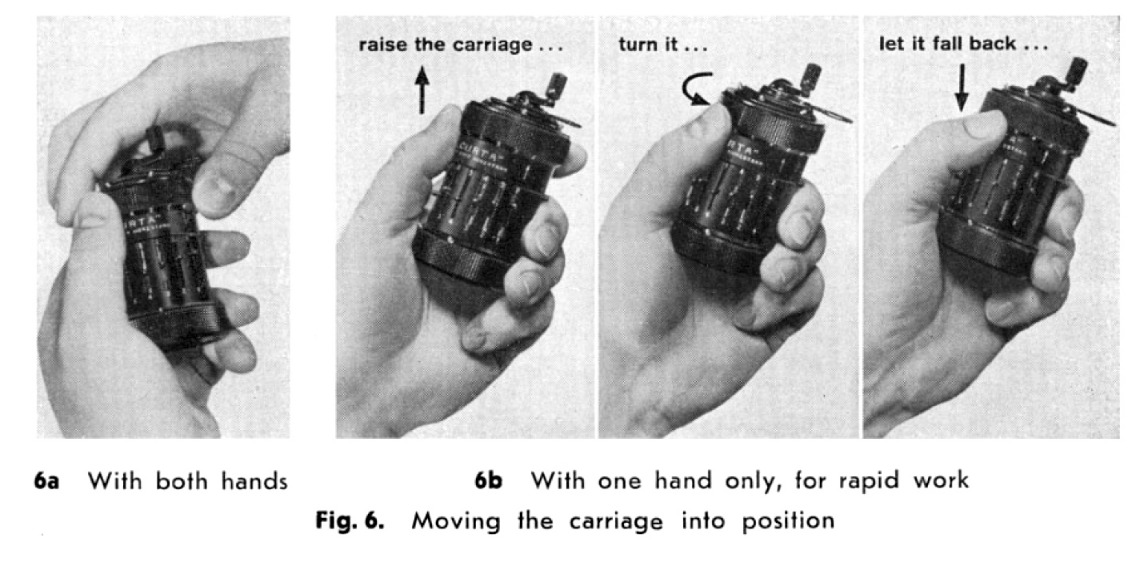
Movement of the carriage can be effected with both hands, as shown in Fig. 6a. For rapid calculation, however, it is better to use only one hand (Fig. 6b). For this purpose, grasp the knurled base ring between the last fingers and the ball of the thumb of the left hand (Fig. 6b). With the thumb and index finger of the same hand raise the carriage, turn it to the required position, then let if fall back into its niche. A safety device against faulty operation mutually checks the handle and the carriage. The handle cannot be operated when the carriage is not resting in a niche, and the carriage cannot be lifted if the handle is not in its stop position. Any attempt to lift the carriage while the handle is being operated is uncalled for and should be avoided.
Clearing
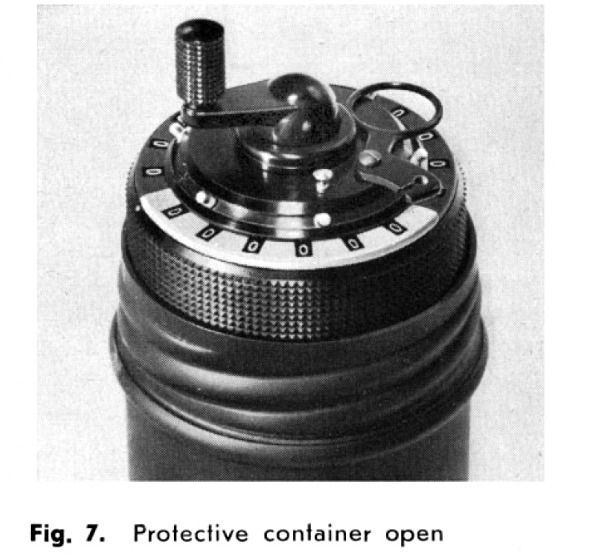
Clearing the counter dials is done by means of the clearing lever, furnished with a ring. The lever, securely fixed during calculations (Fig. 1 and 2) can be released by pressing a button and folded round when the machine is to be placed in its container (Fig. 7). To clear, raise the carriage, and turn the lever in either direction about the axis of the machine. One complete turn clears both dials, but either one can be cleared independently, as there are distinct checks at each boundary between the light and dark dials. After clearing, the lever must rest at the one or the other of these checks, otherwise you can neither lower the carriage again, nor turn the driving handle, This is another safeguard against unintentional errors in operation. (Compare Figs, 1 and 2.)
Reversing lever
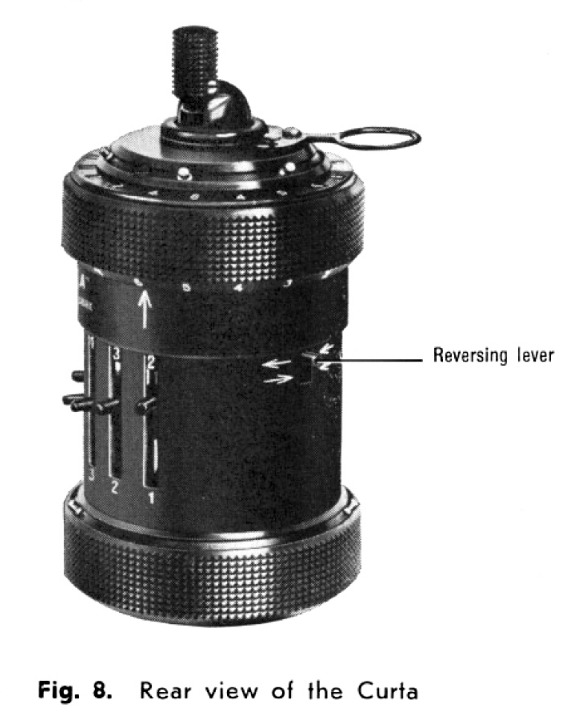
For most operations the revolufion counter is required to show the number of additive rotations, subtractive rotations being counted subtractively, that is, deducted from the number of additive turns.
In certain cases, however, subtractive turns need to be counted up in a positive sense, as, for example, in counting the number of terms subtracted. To do this, push down the reversing lever at the back of the machine (Fig. 8). With this setting the two counters act in opposite senses, subtractive turns being added in the revolution counter, and additive turns deducted.
The two arrows pointing towards each other indicate that in that position of the reversing lever the two counters act in opposite senses. Likewise, when the reversing lever is in the position where the two arrows point in the same direction, both counters act in the same sense, either increasing (for additive turns) or decreasing (for subtractive turns).
The four arithmetical operations
Before starting a calculation, make certain that the machine is ready, i.e. —
- Driving handle at the stop.
- Both counter dials cleared, showing zeros.
- All setting columns at zero.
- Carriage at starting position, indicator arrow pointing on figure 1 of the result dial place numeration.
Addition
Example I. Addition of whole numbers.
- Make the machine ready, reversing lever in upper position.
- Set 3,017 in setting slots 1 to 4.
- One additive turn transfers the 3,017 to the result dial.
- Set 289 in setting slots 1 to 3; the 4th knob reset to 0.
- One additive turn.
- Set 49,722,800 in slots 1 to 8.
- One additive turn.
The result dial indicates the total; 49,726,106; the counter shows 3, the number of terms added.
Example II. Addition of numbers with decimal places,
- Machine ready, reversing lever up.
- The greatest number of decimal places is three, therefore set a decimal marker before figure 3 of the result dial place numeration, and one before the third setting slot.
- Set 1,254.05 in setting slots 2 to 7.
- One additive turn,
- Set 171.4 in setting slots 3 to 6 and reset the other two knobs to 0.
- One additive turn.
- Set 19.075.
- One additive turn.
- Set 214 (first three knobs reset to 0).
- One additive turn.
The result dial shows the sum; 1,658.525; the revolution counter 4, the number of terms added.
In some cases the numbers are set further to the left of the setting dial, and the decimal points accordingly. An example of this possibility will be met with later on.
The following example shows how to proceed if the number to be set exceeds the capacity of the setting dial.
Example III
- Machine ready.
- Set 72,655,829 in slots 1 to 8.
- One additive turn.
- Set the eight last figures of the second term in slots 1 to 8, i. e. 59,681,119.
- One additive turn.
- Move the carriage to the 4th position.
- Set the first three figures of the second term, i. e. 437 in slots 6 fo 8.
- One additive turn.
- Replace the carriage to the first position.
- Set the eight last figures of the third term in columns 1 to 8, i. e. 31,789,854.
- One additive turn,
- Move the carriage to the 4th position.
- Set the first two figures of the third term in columns 6 and 7, i. e. 54,
- One additive turn.
The sum is found on the result dial; 49,264,126,802. The number on the counter is 002003. The figure 3 shows the total number of terms added, and the 2 shows how many of them had more than eight digits.
Subtraction
Example IV. (Subtraction with positive remainder, and counting the number of terms subtracted.)
- Machine ready, reversing lever down. (If you do not wish to count the number of terms subtracted, the position of the reversing lever is indifferent.)
- Secure two places for the decimals, therefore set decimal markers for the setting and result dial before figure 2.
- Set 2,467.75.
- One additive turn.
- Clear the revolution counter, returning the clearing lever to its former position, otherwise it would be necessary fo reset the decimal marker of the result dial in its correct position.
- Set 48, the first number to be subtracted.
- Extend the operating handle to its upper position, and make one subtractive turn.
- Set 834.32.
- One subtractive turn.
- Set 1,207.5.
- One subtraction turn.
The calculation is finished; the result dial shows the remainder; 377.93; the counter shows 3, the number of terms subtracted.
Subtraction with negative remainder
In subtractions giving negative remainders, the result shown is not the remainder itself, but its complement, that is to say, the difference between the numerical value of the remainder, and 100,000,000,000; i. e. the figure 1 followed by as many zeros as there are places on the dial.
Example V
When the calculation is finished, the result dial shows, not 00,000,000,47 but 99,999,999,953. This is the complement of 47. If a calculation leads to a negative result, the appearance of a row of nines in the first places of the dial shows it at once.
Example VI
- Machine ready.
- Set 643,781.
- One additive turn.
- Set 1,274,481.
- One subtractive turn.
The result dial shows 99,999,369,300. The complement of this number is 00,000,630,700. The remainder is therefore -630,700.
This result can be obtained mechanically as follows; --
- Set 99,369,300 (there are no places for the first three nines).
- Two subtractive turns.
After the first subtractive turn the result dial will show zeros, except in the three first places which remain out of operation.
After the second turn we read the actual digits of the negative answer:
The first three digits, in brackets, are to be neglected.
Multiplication
Multiplication is carried out by repeated additions, effected in the successive positions of the carriage corresponding to each of the places of the multiplier and indicated by the arrow.
Example VII
-
Machine ready, reversing lever up.
-
Set the number to be multiplied, 8,549.2, in slots 1 to 5.
-
The product will have as many decimal places as those of both the numbers to be multiplied, taken together, i. e. 6, Therefore set decimal markers: one before the 1st setting slot, one before the 5th place of the counter dial, and one before the 6th place of the result dial.
-
First multiply by the last digit of the multiplier, by making 4 additive turns of the operating handle. The counter then shows 4.
-
The next digit of the multiplier being zero, move the carriage along two positions (the indicator arrow then points to 3). Two additive turns, and the counter shows 204.
-
Move the carriage one more position, indicator at 4; three additive turns of the handle bring the figure 3 into the counter, which now marks 003204, The multiplication is finished; you can check that the setting slots do show the number to be multiplied, 8,549.2; the counter shows the multiplier, 0.03204; and the result dial shows the correct product, 273.916368.
You may, of course, multiply by the digits of the multiplier in any order you please, provided that you put the carriage in the appropiate position for each digit. As long as the setting dial and revolution counter show the correct factors, the result dial will show the correct product,
This can be useful if you have a number of multiplications to do with the same number to be multiplied, but several different multipliers. In this case there is no need to clear any of the dials; we leave the setting dial unchanged, and only vary the number of turns of the handle.
Multiplication with a constant factor
Example VIII
As a sequel to example VII, i. e. 8,549.2 \times 0.03204 = ? calculate, with the same first factor,
Leave the machines as it is at the end of Example VII, without clearing, and proceed as follows; --
-
Move the carriage to the 4th position; (indicator at figure 4).
-
Three subtractive turns eliminate the figure 3 from the revolution counter, which now shows 0.00204 whereas 0.00304 is required.
-
Carriage to 3rd position.
-
One additive turn.
The counter now shows the multiplier, 0.00304 and the result dial gives the new product, 25.989568.
If you notice that the counter is not showing the correct multiplier (should you either have mistaken the number of turns given, or misread the original multiplier), you can adjust its value in a similar way.
If, however, the correct factor has not been set on the setting dial, you must make an entirely fresh start.
Shortened method of multiplication
Example IX
Instead of multiplying 13,974 by 9, let us calculate 13,974 \times (10-1), or -13,974 + (13,974 \times 10); thus accomplishing the calculation in two turns instead of nine.
- Machine ready, reversing lever up.
- Set 13,974.
- One subtractive turn; the counter shows 999,999, the complement of 1.
- Move the carriage to the 2nd position. One additive turn, produces multiplication by 10.
By means of these two turns, the calculation is finished. Owing to the tens carrying mechanism, the second turn has not only corrected the tens digit on the counter, but all further digits as well, so that we read 000,009; this turn is therefore called a zero turn. The result dial shows the product, 125,766.
We could just as well have multiplied in the reversed order, i. e. first by 10, then by -1, but the following example will show that the previous method is preferable, as it requires less reflection, the correct multiplier being built up as if were automatically,
Example X
-
Machine ready, reversing lever up.
-
Set 784.45
-
Set a decimal marker before the 2nd setting slot, one each before the 1st place of the counter and 3rd place of the result dial,
-
The carriage is in its starting position, indicator arrow at 1. One subtractive turn gives 99,999.9 in the counter. The last 9 is the figure required.
-
Move the carriage to the second position. The second 9 needs to be changed to 7, so make two subtractive turns, counting "8", "7", and the counter then shows 99,997.9.
-
Carriage to the third position; the 9 is to be changed to 2; therefore first make a zero turn, then two additive turns an count "0", "1", "2". The counter then shows 00,027.9.
-
Carriage to the fourth position; one subtractive turn produces in the fourth place of the counter 9, the required figure, and we read 99,927.9.
-
The first two nines are to be eliminated, so move the carriage to the 5th position, make one zero turn and count "0". Owing to the tens carrying mechanism, both the first digits are corrected, and the counter shows the correct multiplier, 00,927.9.
The result dial gives the answer: 727,891.155.
In contrast with the ordinary unshortened method, where 27 turns are needed, the method shown here has used only 8 turns, which gives an appreciable saving of time.
In using the shortened method of multiplication, always start building up the multiplier from the right; you can then build up figure by figure, without reflection, merely by counting as above.
Notice the following rules for counting:
a) In making subtractive turns, count backwards; hence, if starting from 0, count "9", "8", "7", and so on, if starting 9 (having left the previous position after a subtractive turn), count "8", "7", "6", and so on.
b) In making additive turns count forwards, thus if the figure at the start is a 0, count "1", "2", "3", and so on; if it is a 9 (the last turn in the previous position having been subtractive), the first turn is the zero turn, therefore count "0", "1", "2", and so on.
c) When the highest place digit of the multiplier has been built up by subtractive turns, you must clear the following places of the counter by a corrective turn, The 6th digit (millions digit) of the multiplier can therefore never be built up by subtractive turns.
Here is one more example, without further explanation,
Example XI
- Machine ready, reversing lever up.
- Set 58,821.
- Carriage in starting position, indicator at 1, Two subtractive turns, counting "9", "8".
- Carriage to the 2nd position, two subtractive turns counting "8", "7",
- Carriage to the 3rd position, one subtractive turn counting "8".
- Carriage to the 4th position, two additive turns counting "0", "1".
- Carriage to the 5th position, two additive turns counting "1", "2".
The result dial shows the product 1,286,885,838.
Division (Additive method)
(Division by multiplication, i. e. reconstruction of the dividend.)
The simplest method of finding the quotient in division is to set the divisor, and multiply it until the dividend appears on the result dial. This answers the question, by what number (quotient) should the divisor be multiplied to produce the dividend? The quotient appears on the counter, and is exact if the result dial shows the exact dividend, or its best approximation, if the division is one which gives a remainder.
Example XII
(The quotient is to be found to as many significant figures as possible.)
-
Machine ready, reversing lever up.
-
Set the divisor 32.4 in the slots 1 to 3.
-
Carriage to the 6th position (maximum displacement).
-
Make additive turns until the result dial shows a number as near as possible to 729. After 2 turns it shows 648, the following places, showing zeros, are to be neglected. A third turn would give 972, which is too great, so leave 648, and correct the digits step by step.
-
Carriage to the 5th position, continue additive turns. 2 of these produce 7128 on the result dial.
-
Carriage to the 4th position. Five additive turns give the result 729, the exact dividend, and the counter shows the figures of the quotient, 225000.
-
The decimal markers are now to be adjusted; one on the result dial, before the 5th place, so that the dividend reads 729.00000; one before the 1st setting slot, as the divisor has one decimal place. Since you have actually done a multiplication, the result dial should have as many places as the setting dial and counter together; i. e. the number of decimal places on the result dial minus the number of those on the setting dial gives the number of decimal places on the counter; in this case 5 - 1 gives 4. The quotient is therefore 22.5000.
Example XIII
(The quotient will be to six significant figures.)
- Machine ready, reversing lever up.
- Set 85998 in slots 1 to 5.
- Carriage to the 6th position.
- Make additive turns until the first digits of the number on the result dial make the best approximation to 4847. After 5 turns it shows 42999.
- Carriage to the 5th position.
- After 6 turns the result dial shows 4815888.
- Carriage to the 4th place.
- After 3 turns the reslut is 48416874.
- Carriage to the 3rd position.
- 6 turns and the result is 484684728.
- Carriage to the 2nd position.
- One turn gives 4846933278.
- Carriage to the 1st position.
- After 7 turns the result dial shows 48469934766. It can be seen at a glance that this is about 65000 units less than the required number, One more turn gives 48470020764, which is 20764 units too many, but nevertheless a better approximation than the previous value.
- The dividend being 0.4847 put a decimal guide before the 11th place of the result dial, Put the decimal point before the 7th setting slot, and therefore the point on the counter comes before the 4th place, The quotient can now be read from the counter, 56.3618.
With a little practice you will soon acquire the knack of reconstructing the dividend on the result dial very quickly, without stopping to think, or even counting the number of turns. You have only to move the carriage place by place, turning until the figures show the best possible approximation. If ever you make one turn too many, thus obtaining too large a number, one subtractive turn will eliminate it, In view, however, of the tens carrying mechanism, you could equally well correct if with the carriage moved to the next position, by making subtractive turns until the result dial gives a number not greater than that required. This latter method is quicker than the former, if the excess to be eliminated is not too great.
If the divisor has more than five digits, you cannot always obtain a six-digit quotient on the counter, as is shown by the next example.
Example XIV
(The quotient to be found to as many significant figures as possible.)
-
Machine ready, reversing lever up.
-
Set 6478356 in slots 1 to 7. The final zero is omitted, in order to obtain the greatest possible number of places in the quotient, but must be taken into account in placing the decimal point later on.
-
Move the carriage to the 4th position. If cannot be moved further over, or there would not be room on the result dial to reconstruct the first digits of the dividend.
-
Two additive turns give 12956712000.
-
Carriage to the 3rd position.
-
Two additive turns give 14252383200.
-
Carriage to the 2nd position.
-
Seven additive turns give 14705868120.
-
Carriage to the 1st position.
-
After seven additive turns the result is 14751216612, the best approximation obtainable.
-
The dividend reconstructed on the result dial has seven decimal places; the divisor on the setting dial has none, therefore there should be seven on the counter, and since a zero was omitted in setting the divisor, there should be eight decimal places in the actual quotient, which thus becomes 0.00002277.
Division (Subtractive method)
In longer calculations with several steps, it may be required to divide a number which has been obtained on the result dial; in this case there is no need to clear the dial, but we subtract the divisor from this dividend until the result dial is brought to zero. The number of subtractive turns is then the quotient, To count them, lower the reversing lever, so that the two counting mechanisms are acting in opposite senses.
It is of course necessary that the dividend should be far enough to the left of the result dial, to give the required number of significant figures in the quotient.
Example XV
(Quotient to 4 significant figures.)
The addition is to be done first, setting the terms as far to the left as possible, being careful, however, that when they are transferred to the result dial, the 11th place is free for the tens digit.
-
Machine ready, reversing lever up for addition.
-
Carriage to the 4th position, there will then be four figures in the quotient.
-
Set 8.858 in slots 7 to 4. The units will then appear in the 10th place of the result dial, and the tens in the 11th place. One additive turn.
-
To prevent any mistake, set the decimal markers at once, before the 6th setting slot, and directly above, between figures 9 and 10 of the result dial place numeration.
-
Set 9.33 in slots 7 to 5. One additive turn.
-
Set 7.506 in slots 7 to 4, One additive turn.
-
Set 9 in the 7th slot. One additive turn. The result shown is 34.694600000; it is now to be divided by 393.632.
-
Clear the revolution counter only; put the reversing lever down.
-
Set the figures of the divisor, 393632, as far to the left as possible, but making sure that the dividend, in corresponding position above, is relatively greater than the divisor; thus the 3 comes to be in the 7th column, the 9 in the 6th, etc.
-
The decimal markers are set thus: one before the 4th setting slot; and on the counter, one before the 5th place, since we already have one standing before the 9th place of the result dial.
-
Extend the driving handle, and make as many subtractive turns as possible, without passing zero on the result dial. After 8 turns the first two figures of the dividend have changed to 03. The 9th turn would have given 99267120000, which would have been a negative result.
-
Carriage to the 3rd position.
-
8 subtractive turns eliminate the first three digits.
-
Carriage to the 2nd position.
-
Only 1 subtractive turn is possible.
-
Carriage to the 1st position.
-
3 turns bring the result dial to 3211840. Directly below, the setting dial shows 3936320. This cannot be subtracted again, and the figures 3211840 on the result dial represent the remainder. If you try one more turn, the result becomes 99999275520; this is the com- plement of 724480, which is nearer to zero than ihe above remainder.
The counter now shows the quotient, 0.08814.
This latter method is only used when the dividend is already on the result dial. Setting the dividend and transferring it to the result dial is not recommended, More-over, it is then necessary to clear the counter, which is very easily overlooked. The additive method therefore eliminates the following three steps: setting the dividend, its transfer to the result dial, and clearing the counter.
Some practical applications
Checking bills
(Addition of products)
| Delivery | Price | Subtotal |
|---|---|---|
| 34.5m | at 24.30 | 838.35 |
| 217.0m | at 19.80 | 4,296.60 |
| 19.5m | at 7.60 | 148.20 |
| 5,283.15 |
| Returns | Price | Subtotal |
|---|---|---|
| 9.5m | at 10.40 | 98.80 |
| 27.0m | at 20.10 | 542.70 |
| Balance Due | 4,641.65 |
First calculate each item separately, without clearing the result dial, so that it shows the total amount due.
Set the number of metres in each length, and build up the corresponding prices in the counter. After they have been set, the decimal markers must remain in their respective places during the whole calculation.
-
Calculate 34.5 \times 24.30.
-
Clear the counter only, not the result dial.
-
Calculate 217.0 \times 19.80.
-
Clear the counter only.
-
Calculate 19.5 \times 7.60.
-
Clear the counter only. The result dial now shows the total sum 5,283.15, Similary, work out the amount to be deducted. (Subtractive multiplication.)
-
Reversing lever down.
-
Calculate 9.5 \times 10.40 with the handle extended to the subtractive position.
-
Clear the counter.
-
Calculate 27.0 \times 20.10 with the handle extended.
The result dial shows the balance due: 4,641.65.
All such problems are done in the manner just shown: i. e.
Percentages
Example I
Add 4.5% to 378.65
-
Calculate the 4.5%, i. e, multiply 378.65 by 0.045 giving the result 17.03925, which would be 17.04 to the nearest hundredth.
-
Calculate 104.5%, i. e. multiply 378.65 by 1.045 by completing the multiplier. To do this, move the carriage to the 4th position and make one additive turn.
The result dial shows the final answer: 395.68925, or, to the nearest hundredth, 395.69.
Example II. Rebate
From 7,288 deduct a rebate of 11%.
-
Calculate 7288 \times 0.11$; the result is the rebate, 801.68.
-
Calculate 89%. Multiply 7288 by 0.89 by modifying the multiplier. The result shown is the net amount, 6,486.32.
Example III. Shortened method
(Simultaneous multiplication of two different numbers by the same factor.) To deduct a discount of 3 %o from 7,683.00.
The 3 is set as far to the left of the setting dial as possible, and the 97 on the extreme right. Multiplying these figures by the gross amount, the result dial will show both the discount and the net amount.
-
Machine ready; set 3 in the 7th slot, and 97 in slots 1 and 2.
-
To delimit clearly the two products, set two decimal markers side by side between the 6th and 7th places of the result dial. To their left, two places further on, set a decimal guide for the decimal point of the discount, and one before the 2nd place for the net amount.
-
Multiply by 7683.
The result dial shows the discount 230.49 on the left of the double point, and the net amount 7,452.51 on its right.
Different discounts and net amounts can be rapidly calculated in leaving the same figures on the setting dial and by simply changing the multiplier.
If the percentage has two digits, or the gross amount has more than four, there is a risk that the two answers may overlap. In this case use the method shown in example II.
Cubes (Without intermediate notes)
-
Calculate 327 \times 327$ The result dial shows the square, 106,929; the counter shows 327,
-
Build up the counter to 106,929, starting from the left-hand digits, so as not to interfere, during multiplication, with the remaining figures on the result dial. In this way there is no need to write down the square, nor to memorize it.
a) Carriage to the 6th position. The first figures of the result dial being 1, the first figure of the counter needs to become 1, so make one additive turn.
b) The following figure of the result being zero, the carriage can skip a place,
c) Carriage to the 4th position; the next digit of the result dial is 6, so turn the handle until the counter shows 6 in the corresponding place.
d) Carriage to the 3rd position, The corresponding digit of the result dial being 9, turn the handle until 9 appears next in the counter.
e) The next digit on both result dial and counter is 2. The carriage can therefore skip a place.
f) Carriage to the 1st position. On the result dial is 9 and on the counter 7. Two turns of the handle change the latter digit to 9.
The calculation is completed. The setting dial shows 327; the counter shows the square 106,929; the result dial therefore shows the required cube 34,965,783.
Rule of three
1st Method
1 gross costs 180.00. What is the cost per article? What is the cost of 46 articles?
-
First calculate 180 - 144 by the additive method. The counter shows the cost per article, 1.25.
-
Then calculate 46 \times 1.25; there is no need to clear the counter, but proceed thus:—
a) Clear the result dial only.
b) Set 46.
c) Reversing lever down.
d) Make additive turns until the counter is clear.
The result dial shows the cost of 46 articles, 57.50.
2nd Method (Simultaneous division and multiplication).
-
Set 144 at the extreme left of the setting dial, i. e, in slots 5 to 8. Set 46 in slots 1 and 2.
-
As before, calculate 180 - 144$ by the additive method. In making this division, the multiplication of the quotient by 46 (the number of articles) takes place automatically on the right of the result dial. The counter shows the price per article, 1.25.
This method is very quick, but can of course only be used when the numbers in question do not have too many digits, and thus risk interfering with each other.
3rd Method
If in calculating an expression of the type
the division gives a remainder, you would obtain a better approximation to the final answer by multiplying first and dividing afterwards, but in this case the quotient a\over c which is the price per article, is not found.
Square roots
1st Method (Topler)
This method is based on the fact that in the Arithmetic Series
the n^{th} term is always (2n - 1), and the sum of the first n terms is n^2.
This method will be explained further by means of a simple example, but those not concerned with mathematical principles need not read the inset paragraphs; an account of the mechanical steps needed will be found under Example II.
Example I
Let \sqrt{1369} = x
The root will have two digits; let the tens digit be "a", and the units digit be "b". Then,—
-
First "a" is to be found in the tens column, giving the value 10a. To obtain this, build up the square of 10a, i.e, 100a^2, by the aid of the series given above. Watch the result dial for a number as near as possible to 1369.
a) Carriage at the 2nd position.
b) Set 1 in the 2nd slot; one additive turn.
c) Set 3 in the same slot; one additive turn..
d) Set 5; one additive turn.
The result shown is 900, which is near enough to 1369; if 7 is set and added, the result is 1600, which is too much, The missing value between 900 and 1369 corresponds to the expression 20ab + b^2.
The counter is showing 3, which is the value of "a".
-
Now to find "b". The value of b^2 is found by building up the series from setting slot 1, until the expression 20ab + b^2 becomes exactly equal to the value needed to complete the 900 on the result dial to 1369.
For this purpose 20a must also be set, which is obtained by increasing the last figure set by 1. (The n^{th} term was 2n — 1, therefore the n^{th} term plus 1 will be 2.) In this way each turn of the handle will transfer not only b^2, but also 20ab, thus adding the required value 20ab + b^2, which is lacking from the result dial.
a) Set the carriage at its 1st position.
b) Increase the 5 in the 2nd slot to 6.
c) Set 1 in the 1st slot; one additive turn.
d) Set 3 in the 1st slot; one additive turn.
e) Set 5 in the 1st slot; one additive turn.
f) Set 7 in the 1st slot; one additive turn.
g) Set 9 in the 1st slot; one additive turn.
h) Set 11 in the "1st slot"; that is, set 1 in the 1st slot, and increase the 6 in the 2nd slot to 7. One additive turn.
i) Set 3 in the 1st slot, one additive turn.
The result shown is 1369, the original number, and the counter indicates 7 in the first place, now showing 37 altogether, which is the required root.
Example II
The number is to be split up into groups of two digits, starting in both directions from the decimal point;— 30|29,40|00|00. Each pair corresponds to one digit of the root, Since the result dial has a capacity of 11 places, 5 significant figures of the root can be built up, or even 6 if the first group contains only one digit (as in
7|61,24|50|00|00). The root will have as many decimals as there are groups after the decimal point; therefore, in our example above, three decimals.
-
Set the carriage at the 5th position (corresponding to the number of digits to be obtained in the root).
-
Build up the Arithmetic Series, given above, from the 5th slot (likewise corresponding to the number of places in the root).
a) set 1 in the 5th slot; one additive turn.
b) set 3 in the 5th slot; one additive turn.
c) set 5 in the 5th slot; one additive turn.
d) set 7 in the Sth slot; one additive turn.
e) set 9 in the 5th slot; one additive turn.
The result shown is now 2500.000000; the 5th digit of the root has been found. It is easily seen that if 11 were added, the required value would be surpassed,
-
Increase the figure now in the 5th slot, by 1. In this case change if to 10 by setting 1 in the 6th slot and 0 in the 5th. The setting dial should now show double the value shown on the counter, and if is as well to check that at this point.
-
Carriage to the 4th position.
-
Once more build up the series given, by setting 1, 3, 5, 7, 9, successively in the 4th slot, with an additive turn after each one, The result shown is now 3025.000000 and the 4th digit of the root is found.
-
Increase by 1 the 9 in the 4th slot. The setting dial then shows 110.000 and the counter 55.000.
-
Carriage to the 3rd position.
-
It is not possible to build up the series at all in this colmun, as the required value is already surpassed by the addition of 1. Pass directly to the following position.
-
Carriage to the 2nd position.
-
Build up the series from the 2nd slot by setling 1, 3, 5, successively, with an additive turn after each one.
-
Increase by 1 the 5 set in the 2nd slot, giving 6.
-
Carriage to the 1st position.
-
Set 1, 3, 5, 7, 9, 11, 13, 15, 17, one after the other in the 1st slot, with an additive turn after each, To set 11, set 1 in the 1st slot, and increase the figure in the 2nd slot by 1, from 6 to 7; for 13, 15, 17, if is then only necessary to set 3, 5, 7, in the 1st slot.
The result shown is now 3029.291521; setting and transferring 9 from the 1st slot gives 3029.401600 which is a better approximation to the required value. The counter then shows the root, which, correct to 5 figures is 55.040.
Check once more that the setting dial has twice the value of the counter, less one.
2nd Method (Herrmann)
If an approximate root is known, the result can be obtained more quickly.
"N" is known to be the approximate square root of "R", its error being "f".
which, divided all through by 2N, gives
First calculate N^2. Then set 2N, and multiply until the N^2 shown on the result dial increases to R. This proces is in effect the division: {R - N^2\over 2N}; its quotient f + {f^2\over 2N}, beign added to the N already on the counter, thus giving N + f + {f^2\over 2N}, which is the required root plus a small error, {f^2\over 2N}.
By an exact determination of the possible error, it can be shown that provided the approximation N has at least half the number of correct digits, wanted for the root, the answer obtained by the above method will be correct, except in a few cases where the last digit may vary by one.
As the following example shows, it is always possible to find the root to six significant figures, of any number whatsoever, from an approximation to three figures, which may be obtained from tables or by calculation.
Example
\sqrt{16.8} = ? (The root to be found correct to six significant figures.)
We start from a the approximation 4.10.
-
Calculate 4.10^2; arrange the result to come out at the extreme left of the dial, in order to obtain six places in the root.
a) Carriage at the 6th position.
b) Set 4.10 as far to the left of the setting dial as possible, in this case in slots 5 and 4.
c) Calculate 4.10 \times 4.10; i.e. 4 turns with the carriage in the 6th position, and 1 turn with the carriage in the 5th position.
-
Without clearing, build up the original number by multiplying by twice the approximation.
Postscript
When you have read carefully through this little booklet, and mastered the working of the examples given, you have received a first-class preparation for all kinds of everyday calculations. It is practice which makes perfect; with a little practice you will quickly master the machine completely and thoroughly enjoy working with it.
This manual was transcribed from the excellent curlta.li site, where you can see the original scan of the English manual.